Charles River

Charles River
Upper Limit Cloud/Lower Limit Sail

Derrida

"Messianicity is not messianism ... even though this distinction remains fragile and enigmatic." (Jacques Derrida)

Monday, May 15, 2023

Knowing, Alex Proyas (2009)

N.B. I wrote this review shortly after the film came out. Originally it was to be part of a longer piece on SF films whose central themes dealt with latent or hidden extra-solar codes that hold the secret meaning of human history. This theme is locatd at the juncture where teleology succumbs to the pathology of paranoia. Other films to be considered were "Prometheus" and "Stargate." The piece isn't quite finished. I offer it here FWIW. Having also directed "Dark City," "I, Robot," and others, Proyas, along with Andrew Niccol, is one of the most prominent among contemporary SF auteurs at work today.

Like the comedy Ghost Town (2008), this 2009 film directed by Alex Proyas belongs to an emerging class of post-9/11 films that offer consolation by way of displaced representations or allegories of grief. It is also a film about the dangers of the risk society. More importantly, for this discussion, it exemplifies many of the features of the alien artifact film. The first two elements, it should be noted, are combined in the figure of the second of two ghosts who occupy and drive the film’s protagonist, John, namely, the figure of his wife, who, we learn via backstory, died in a hotel fire. The means of her death – by the failure of a building – seems designed to echo or point to the larger catastrophe of the World Trade Center’s structural collapse. Both events – the actual disaster and its pared down fictional counterpart – indicate the basic unreliability of modernity, the fact that structures and entire systems can overload or breakdown, often without warning.

[As an MIT astrophysicist, John is actually little more than a mouthpiece for the script’s metaphysical nostalgia. In an early classroom scene he expounds tritely on whether or not the universe functions by design or randomness, teleology or contingency. Later, he tells X that he thought he was supposed to feel it when his wife died, halfway around the world.]

The film’s prologue is set in a 1959 Lexington, MA elementary school named for William Dawes, a heroic Minuteman, invoking both the early alarms of the Revolutionary War, Cold War paranoia and the threat of total destruction, and a perverse boomer nostalgia for lost innocence. The installation of a time capsule (undertaken while a brass band badly plays the pastoral-triumphalist portion of Holst’s “Jupiter”) likewise signals both the onset of an alien knowledge that drives its child possessor Lucinda (the story’s main ghost) to dementia and eventual drug overdose. As we learn she is unwillingly subjected to transmissions from the alien archive of the future in the form of telepathic noise represented as overlapping whispers, which she is forced to translate into a series of seemingly meaningless numbers. The gleaming time capsule itself emblemizes Cold War anxieties with its burial of the now for some possible future retrieval, even after Armageddon. What its designers hope will stand as a message to the future becomes for that future a note from the angel of death.

[Brief note on time capsules: 1939 World’s Fair – to be opened in 6939. Implies an absurd faith in the future; it's meant to foster a hope in continuity, but becomes instead a message from our ruins to latter-day archaeologists and an acknowledgment of our fragility].

The film’s core theme – astrophysical theories of randomness versus determinism (a code word perhaps for intelligent design) – is explicated in an MIT lecture by the hero, John Koestler (the last name here rather needlessly alluding to Arthur Koestler and his book on the paranormal, The Roots of Coincidence). Still grieving the loss of his wife, J. appears consumed by the theory of randomness – “shit just happens” as he bitterly tells his class – there is no higher or larger meaning or design. Here the film plays up the binary of randomness/determinism all too reductively, as though the former were equivalent to nihilism and not some form of deeper complexity and emergent systems behavior that develops rhizomatically into decentralized self-organizing systems. "God," in this view, is not merely in the details; he is the details.

After his son Caleb, during a ceremony marking the opening of the time capsule, receives the mad scribblings of the girl from 1959 (Lucinda Embry–the name portentously suggests both illumination and embers) it becomes clear that her random strings of numbers depict a map of worldwide disasters. Some of these disasters are natural – earthquakes, hurricanes, tsunamis – and some are man-made: 9/11, the first one decoded; along with other plane crashes and massive infrastructure failures.

While this mix of registers proves fatal to the film’s logic, we might read these disasters as all man-made in the sense that the high death tolls they incur are the result of massive population clustering in narrow coastal and urban areas which lack adequate alarm and evacuation procedures. Cities, in other words, like buildings, or planes, or cars, are death traps, waiting for the right set of random circumstances to trigger their destruction. The conditions produced by the risk society greatly increase the likelihood of the traps’ chances to engulf its inhabitants.

John is able to decode the alien archive further and realizes that three events have not yet occurred. The first one (which leads to the decoding of the remaining set of unexplained numbers as lat/long coordinates) is a spectacular crash of a commercial airliner over I-90. This disaster revisits the trauma of 9/11 in a visible way, even if on a reduced scale. Improbably, as part of its fantasy of redemption, John staggers through the plan’s scatter path as EMT’s, who’ve arrived with miraculous alacrity, escort a few improbably surviving passengers away from the burning wreckage. He decodes, but is also unable to stop, the second of three remaining disasters on the list, this one involving a subway crash in NYC.

Both of these disasters are like compulsive re-enactments of both 9/11 and his wife’s death. His foreknowledge of them only makes him feel more impotent to stop them. He becomes a Cassandra-figure, isolated in his ability to make his warnings understood by the authorities, the classic position of the hero outlined by Sontag in her early, influential essay “The Imagination of the Disaster.”

Teleology here undergoes a shift from the dream of a completed totality, the fulfillment of history through universal emancipation, to a paranoid sign system in which all things, once understood as interconnected and legible, only signify total destruction and universal anarchy. The knowledge of all things is a zero-sum game. In a related sense, the knowledge of the beyond – of the future – which the alien archive transmits (thereby contaminating its readers with a kind of lucid dementia) is also a form of religious experience, a conversion from the placid containment of unbelief’s protective repression to belief’s holy terror.

What the alien archive finally represents is a theology of trauma – apocalypse, followed by survival of the chosen ones. The conversion experience John undergoes and later, if more reluctantly, Lucinda’s adult daughter, Diana, allows them to make sense of their pain and loss – which, finally, is the task of stories and art in general. The archive or code may not save them, but it does offer shelter for their children, thereby insuring a future for the human. [The SF Ark. The aliens have come to shepherd Earth’s children to a new planet, a rather sappy vision of the Wordsworthian sublime]

The logical link between man-made disasters and the planet-killing solar flare which strikes at random is never made by the film. The earthly disasters are produced by a risk society; they are the result either of the hazards of accelerated modernity or its corollary, the reactionary forces of political terrorism. The solar flare is a cosmic accident. It could be argued that it embodies the ultimate form of risk – that of living at the mercy of enormous and ungovernable stellar forces. But in the progression of disasters the film asks us to see that all disasters are somehow created equal: the only difference between the collapse of a bridge or a downed jet liner and the end of all life on earth is one of scale. This preposterous logic makes a hash of “Knowing’s” theological intervention, reducing it to a cynical ploy, an exploitation of the audience’s hopes for redemption.

The film’s dramatic ending, with a fleet of spaceships leaving Earth to deliver the children to a new world, can actually be read as a fantasy projection of the protagonist, somewhat in the vein of The Sixth Sense. John’s research has already revealed to him the threat the sun poses to the earth. The occult code of numbers, the menacing, black clad strangers (the Whisper People) who appear to be threatening his son only to transform into rescuing angels, all this is simply a delusion he has concocted to shelter him from his own knowing of the inevitable apocalypse. These angels are not rescuers, though; they are angels of death, and the new Eden we are shown at the end is merely John’s fantasy of a Heaven which does not exist. This becomes clear when we consider how this scene is cross-cut with John’s reconciliation with his minister father.

The rescue of the children and their transportation off-world to a new Edenic home, complete with a heraldic white tree, brims with Christian sentimentality; a sugar-coated denouement to the apocalypse. The trench-coated aliens transform into glowing angelic beings and the staging of the earth’s death takes on the trappings of the sublime. John, “left behind,” makes peace with his estranged father, a Christian minister, who assures him that death is not the end. This is a science fiction version of the Rapture.

How, then, to read the role of the alien archive in this compelling, but finally cloying, drama of trauma and redemption? The chain of numbers delivers random occurrence into the emplotment of knowing, that is, of pre-determined meanings which, properly decoded, spell salvation. Yet the connection between human catastrophes and the planet-killing solar flare is made tenuously, at best. The archive does not provide answers to this; only further obfuscations. The smaller disasters of history, according to the film, are to be understood as teleologically-driven, preludes leading up to the final disaster, which is itself a leap outside the logic of history, randomly driven, but responded to providentially.

The antithesis to knowing, of course, is believing. All of John’s knowledge of both science and the future don’t give him the power to alter the course of events. Only by returning home again, like the prodigal son, is he able to reinvest himself with the comforts supplied by faith.

Saturday, November 19, 2022

My David Bowie

The first time I heard David Bowie was my freshman year in college: San Francisco State, Fall 1975. My new best friend, W., occupied a handsome suite in the 14-storey Verdugo Hall, much nicer than my cramped shabby room in Font Hall. We’d hang out, skipping classes and getting high all day, occasionally making films with the 8mm camera he had on loan from the film department. We shot on the roof of Verdugo (illegal) and in the fields of Marin County, where Christo’s miraculous Running Fence snaked across grassy ridgelines. Once, we shot a sword fight in the Japanese Gardens in Golden Gate Park. No one thought twice about it. One of W’s film major buddies was sleeping with his female professor. That’s just how it was in those days. I could walk down Market St. openly smoking a joint.

We listened incessantly to “The Man Who Sold The World” and “Ziggy Stardust.” At one point, I feel quite sure I thought the latter was the greatest album I’d ever heard. The Sgt. Pepper of the 70s, as one pal put it, probably quoting a line from Rolling Stone. We got stoned and watched “Star Trek” re-runs and argued about Sartre. We were all idiots. But god, what a great time we had in our sprawling decadent ignorance.

I began wearing beautiful suits I’d found at thrift shops, complete with cufflinks. In imitation of Bogart in “Casablanca,” I sported a tan trench coat and a fedora. I grew obsessed with Garbo and Dietrich because in San Francisco at that time it was just part of the larger gay cultural atmosphere. The newly re-opened Castro Theater, a fabulous art deco movie palace whose program featured Warner Bros. gangster films and MGM musicals, became a second home to me. I smoked cigarettes and affected a pretentious cosmopolitan air, complete with faux British accent. As fate would have it, my first real girlfriend, N., also a massive movie and Bowie fan (we saw “Children of Paradise” several times together at the Surf Theater) had been raised a 7th Day Adventist and refused to go all the way. There followed what seemed like endless nights of dry humping in an apartment I shared with a pot dealer, J., on Guerrero and 24th, on the edge of the Mission District, which in those days was still a bit sketchy.

When I moved back to Huntington Beach in 1977, these guises and interests faded away. Our little group of culture fanatics was immersed in Bowie, but also Roxy Music (a natural extension), Eno, and the burgeoning punk scene. Bowie’s romanticism still exerted a powerful aura, though. The heady, naked yearning of “Word on a Wing” or “Wild is the Wind” was like a drug. “Wild is the Wind” especially carried an extraordinary power. An aria of sheer longing, it stripped you bare, reduced to pure trembling emotion. It offered kenosis and embodiment at the same time. Erotic longing as decreation? Bowie wasn’t just a sensuous rocker; he was our Sinatra and Elvis, combined. Of course, Sinatra was our Sinatra, too. Bowie led quite readily to “In The Wee Small Hours of the Night” and the rest of the Chairman’s catalog.

With Bowie’s departure a significant chunk – not of my youth, which is long gone – but of what it meant to be young is in no way lessened but magnified. Till his death, I had no idea how much he meant to me. He was just there – a kind of structure of feeling for feeling. When Lennon was murdered, I was devastated. I remember finding out about it by picking up the LA Times on the way to work that morning. The bus ride, the whole day in the office, passed in a daze. But I didn’t grow up with Lennon or The Beatles in the same way I grew up with Bowie. He made it safe to be, not dramatic, exactly, but passionate and lyrical and free to revel in artifice. Life was theater, his songs said, but that theater was real – more real than anything, because it made reality bearable – and without that theater, without the power of artifice, the whole thing was a brutal joke and a lie. Bowie’s theater made it possible to re-imagine your own life. He was the great champion of the weird and the different.

Oh you pretty things
Don’t you know you’re driving
your fathers and mothers insane?
Let me make it plain.
Gotta make way for the homo superior.

The allusion to the X-Men and mutants says it all. He told us we could invest our lives with glamour, even if it was a borrowed glamour. That it was OK, even cool, to be different.

But Bowie’s appeal went beyond even that. There was something gnostic about his many personae and his dangerous songs poised on the edge of nothing, as Simon Critchley so smartly characterizes them. Gnosticism in rock is not nihilism nor hedonism. It’s the recognition of alienation in a world made by an alien god. Bowie was the poet laureate of gnostic rock – of otherness, difference, weirdness. His music’s power came not from about singing about loss, which the blues and rock have always sung about, but a more fundamental metaphysical predicament having to do with being adrift in being, with the flux of identity, the fluidity of the self and the power of music to conjure multiple avatars out of a desire for belonging, even while realizing that heimlich will always be unheimlich.

Perhaps Bowie’s most gnostic turn came in the Nicholas Roeg film, The Man Who Fell to Earth, based on the novel by Walter Tevis. The story is one of an alien’s attempt to rescue the remnants of his race from their dying planet by bringing them to Earth. But his introduction to earthly culture leads him to become an alcoholic (in fact, the novel is a brilliant account of alcoholism as a kind of gnostic amnesia, along the lines of “The Hymn of the Pearl”) and he forgets his mission, succumbing to apathy, amnesia, and despair – trapped in the world of gross matter. The gnostic turn becomes an elegy for a fallen race.

So many of Bowie’s songs are suffused with a sense of elegy. From “Memory of a Free Festival” to “Blackstar,” he gave us a sense of the pleasures and sadness of the fleeting, the mortal. Bowie recognized, as no rock star before him had, that we are always double, always split, always sliced in two by the mirror. Rather than try to heal that split, he owned it, exploited it, claimed it as the heritage it was. His songs proclaimed that we are multiple rather than singular, and that that was a good way to be.

Tuesday, November 15, 2022

Annals of LA: Remembering Dutton's Books

Davis Dutton, known only and always as Dave, ran Dutton’s Books in North Hollywood for something like 30 years. His father founded the store around 1960 and after a career in journalism, which included a successful stint as editor of Westways, back when it was a real magazine, Dave took over when he retired. Situated on Laurel Canyon near the corner of Magnolia, it was a large, ramshackle structure, parts of which, judging by the layout, might once have belonged to a residence, with tiny alcoves resembling long gone closets or bathrooms, and other parts wide open shop spaces with wall-to-wall bookcases running three sides of the room and free standing shelves and tables in the middle, no higher than five feet, which gave the place, for all its overcrowding, a free and easy feel. The front faced west, onto Laurel Canyon, and was glass from about two feet up to the ceiling. It was, in the classic used bookstore cliché, a glorious, disheveled mess, a true blue fire trap. And for a brief time, about two years (1988-1990) it was my home away from home.

Dave was an utterly sanguine type. I never saw him get flustered or out of sorts. There was a deep kindness to the man, a total refusal to sit in judgment even when it was so obviously called for. He kept the radio dialed to the local classical station, KUSC, which is how I first came to hear Vaughn Williams. The 5th Symphony and the Fantasia for Thomas Tallis were on constant rotation back then and they entranced me.

Dave and I grew quite close in a short time. I was just starting to find my way as a poet. It was at Dutton’s in 1989 that I discovered Michael Palmer's "Notes for Echo Lake" and Susan Howe's "The Europe of Trusts" -- books that changed everything I thought I knew about poetry. Dave out me in charge of the poetry section and it was at Dutton's that I launched my short-lived poetry journal, Antiphony. Short-lived as in it enjoyed all of one issue. Funding was the problem. But that first issue was rather sweet, if amateurish. Four of us book clerks were poets: myself, Eve Gardner, Elena Phleger, and Herman Fong, who was the closest among us to being a real poet, someone with actual publications, and boasting an MFA from UMass-Amherst where he’d studied with Jim Tate. It was rounded out by contributions from three old college friends: Michael Forrest, Steve Tracey, and Fuschia.

Dave had purchased Will and Ariel Durant’s library and had stored it offsite. Not, perhaps, the best site for persevering it. But as I learned, the secret of his thriving empire lay in shrewd real estate investments. He owned many homes across the Valley, which he rented out, and this income helped to subsidize the stores. He had three of them when I worked there: the main one, on Laurel; the Burbank store; and a downtown location in the lower level of the ARCO tower, which was home to major law firms like Gibson, Dunn, and Crutcher.

The Durant library was his pride and joy. I often wonder what became of it. Did he sell it off? Donate it? Once he cracked open a box and dug out a red Loeb Library edition of some Roman author -- it might have been Seneca, but I can’t remember now. The book was heavily annotated in Durant’s fine, spidery hand. Written in the margin of one page, he’d exclaimed, “Utter rubbish!” This was fine stuff.

Another time we were retrieving books from one of his garage depots to fetch back to the store in his rickety two-tone VW van, a vehicle which itself served as a mobile book depot and was so overloaded with boxes I was in constant anxiety when I drove it. Would it even shift out of first gear? (Dave also owned a classic white T-bird from the 50s). Dave hauled up the garage door. We were on a non-descript cul de sac of dull ranch-style houses – the Valley is full of them. A black widow spider hung in its messy web about waist high, in a tangle of shelves and boxes. Another person, quite blamelessly, wouldn’t have thought twice about casually swatting it out of existence, say the way Detective Randall does when he and Marlowe explore Jessie Florian’s garage in “Farewell, My Lovely.” Dave chose a different approach. Tenderly, with a rolled up newspaper, he coaxed and cajoled a very reluctant spider out of its nest and harm’s way so he could get at the box he needed. I think at one point I made some exasperated interjection. I simply could not fathom the patience he took to spare this dangerous animal. He quite calmly batted my objections aside. And I stood there, humbled, in awe of what could only be called a quality of grace.

Another book mission, in the rattle trap van, took us up a long narrow winding lane in the hills, somewhere above Sherman Oaks. It was quintessential LA. Spanish tile roofs. Palm trees. Mercedes on the curb. The good life. Dave pointed at a tree. “When I was a boy I saw an angel in that tree,” he said mildly. I saw no reason to question or even wonder at it. I believed him implicitly. Like Blake and Thoreau, Dave Dutton enjoyed a very direct rapport with the world that most of us are barred from.

The bookstore itself housed some 350,000 volumes, new and used. Dave was always buying, always scouring estate sales and the like. Some authentic old school book scouts brought him rare finds. The kind of vanishing type best described in the Cliff Janeway detective series by John Dunning, like “Booked to Die,” and “The Bookman’s Wake.” Grizzled unkempt eccentrics who looked like they’d just washed up to shore but who possessed deep fonts of expertise in the book trade and rare and first editions – a kind of hard won knowledge not to be found on the internet. Dave, who knew his stuff, and who was the great champion of the downtrodden and the underdog, relished shooting the breeze with these guys when they drifted in with some odd, precious cargo.

The store also functioned as a kind of waystation for those of us who worked there. The assistant manager was a classic book nerd type, whose dry wit and stoic demeanor belied a real sweetness: Steve Daly. David Abbott was an actor on the make, incredibly good looking and charismatic. He wrote and starred in a one man show about Van Gogh that was truly brilliant. And then there was the mysterious Amy Albany. Petite, with large blue eyes, platinum blonde hair, and always clad in vintage dresses – I’m pretty sure we all had aching crushes on her. She was sweet, haunted, wounded and not a woman to suffer fools gladly, Her father was the great jazz pianist, Joe Albany, who’d been a sideman for Bird. She gave me cassette tapes of his work which were thrilling. He’d become a junkie and died from his addiction and it visibly haunted Amy. She went on to write a book about him and produce a moving film, “Low Down,” as a tribute to his genius.

Then there was the great Rushdie dust up. When “The Satanic Verses” came out in 1989, the Ayotollah, as is well known, put out a contract on Rushdie, or declared a fatwah. Rushdie was forced to go into hiding, assume an incognito, and keep his head below the parapet for a few years. Bookstores which carried his novel were said to be in the crosshairs too. But Dave refused to knuckle under. We proudly displayed “Verses” in the storefront windows. The LA Times did a story on us and carried a picture of the crew, looking stoic and heroic. I never really thought we’d be the target of a terrorist attack. But it was all bit a heady and unnerving and the entire incident only served to deepen my admiration for Dave. He didn’t make a big show of it. It was more like a low key, “hell, no.” Thoreau, again.

One of the great things about working at Dutton’s was the actors who came in. I engaged in energetic conversations with JT Walsh and Williams Daniels about Dickens and other show folks. Molly Ringwald's family home stood on a side street off Laurel. Her father Bob was blind and sang in a first rate barbershop quartet. I remember helping her finds some obscure titles on jazz. The store had a great film section. It’s where I first bought “I Lost It at The Movies,” and “The American Cinema: Directors and Directions, 1928-1969.” And there was a nice sideline to be had in renting out leather-bound books to studios for set dressing. When Steve Haft, the producer of “Dead Poets Society,” ordered so many linear feet of books, we delivered. Somehow, someone in the store, got me a copy of the script. After reading it I had the temerity to write Mr. Haft with some recommendations about the choice of poems the script featured. Instead of using Vachel Lindsay’s racist and obnoxious “Congo,” why not go with Whitman? I was pretty obnoxious. But then, I never thought much of the movie.

I’m pretty sure I got this script by way of a Dutton’s regular, a classic gentleman of the old school by the name of John Myhers. He was a jobbing actor whose chief claim to fame was, I suppose, his role in the film version of “How To Succeed in Business without Really Trying.” He was effortlessly gracious and charming – a total ham and a wonderful racounteur. He was in the store nearly every day -- just came to shoot the shit with Dave. I felt a bit sorry for him. But he was a generous man. One day he took me aside and said, look here, you ought to be reading screenplays! And he put me in touch with his agent, a woman named Shirley Mann, who maybe was once married to the celebrated director Daniel Mann. Or was it Delbert? Who knows? It was entrée to a whole other world.

Shirley had a nice little office on Sunset Blvd. But not the really nice part. It was just shy of, that is to say, east of Crescent Heights. It was Crescent Heights adjacent, one might say. But I was too naïve to note the distinction then. My interview was brief. She just assumed I knew what to do. I only read two or three scripts for her, for peanuts, as I recall – maybe $40 each? They all had to do with werewolves. One of them was pretty good. Her method was unique and quite efficient. I was to come into the office and type out my report on a large double-sided index card, back and front. Front for synopsis, back for analysis. Like I said, efficient. It was really all these B-movie scripts deserved.

From there I branched out: ITC, Viacom, Lightstorm, Kathryn Bigelow, HBO – everything else. But that’s another story.

Dave hated doing book signings and I much later came to know why. They’re a lot of bother and trouble and very few copies get sold. Having given many readings myself now, I can say that book signings are transitory tributes to an author’s vanity. His younger brother Doug, who ran the fancy, upscale Dutton’s Brentwood on San Vincente over on the west side, excelled at signings. The likes of Margaret Atwood would drop by to shill her wares. But Dave wanted nothing to do with them. The one exception I can recall him making was for his old pal Larry McMurtry. Larry was himself, besides being a Major Author, a bookseller of no small repute. When he came to town, Dave closed the store so that Larry could roam the shelves unhindered by the public, while a few of us stood respectfully in the wings should the Great Man need anything. It was all a bit theatrical and somewhat out of keeping for Dave. But he was just helping out his old buddy.

No account of Dutton’s can be made without the luminous presence of his wife, Judy, who I am convinced was the secret genius of the place. Judy had a kind of swoony zaftig grace and a razor sharp wit and oh yeah, she also kept the books. I’m quite sure the place would have floundered without her capable guiding hand. Every year, she would re-read “Pride and Prejudice.”

Dave Dutton was like a second father to me. I don’t know why he brought me under his wing but I will always be grateful for it. He died a few years ago -- Alzheimers -- up on Whidbey Island. His niece, whom I've never met, wrote me to let me know. I guess I was on some list of people he wanted notified. Even in death, he was still reaching out.

Friday, October 7, 2022

On First Coming to Harvard

One of the first things I told myself when I arrived at Harvard in the fall of 2006 as a Lecturer in History and Literature was, “don’t get colonized.” This was a bit like saying, right you before jump into a swimming pool, “don’t get wet.” Resistance to the swamp that is Harvard was futile, and reader, after eight years there I was good and soaked.

Nevertheless, my initial efforts to stay grounded and maintain a sense of balance amid the intimidating glamour of the Harvard aura proved moderately effective, at least at first. I was no damned historicist, no sir; I stuck to my theory guns and secretly poo-pooed all the vulgar American Studies types I found myself working with.

Still, a doubt nagged at me. Not only were they all better dressed than I; they seemed to speak a private language, an idiom of their own that they’d absorbed from their famous professors in Am Civ or History or even English. I was an outsider. A guy from the hinterland, who’d earned his doctorate at the University of Colorado at Boulder and worked on that most unfashionable of subjects, poetry. What did I have in common with scholars who worked on race relations during the Cold War, or the history of the NEA?

Defensive and unsure of myself, I sought to fend off this invasion of Harvardization, which I took to be a creeping mental poison, a slow spiritual death that led by degrees to an ever-more inflated sense of self-importance, entirely irrespective of one’s actual accomplishments or one’s dubious position on the greasy pole of academic hierarchy. When I heard a graduate student ask, in all innocence, and with more than a bit of disdain, “what is cultural studies anyway?” at a cocktail party I nearly flipped. How could these people be so naïve about the state of our field?

(Reader. she later became a dear friend – because, you know, Russians are the best.)

But the desire to fit in, to belong, is strong. And after a while, as I learned, historicizing adds a new dimension to literary studies which I soon began applying to my own work, even if, as a formalist, I remained skeptical of its claim to serve as an all-explaining matrix. My succumbing to the Harvard way happened in stages and really, I can only plead self-defense, an urge to camouflage myself, chameleon-like. First, I cut my usually long, unkempt hair a bit shorter. Second, I invested in a couple of good, all-purpose sport coats and dumped my stone-washed jeans for some higher quality denim from The Gap and Banana Republic. I credit my girlfriend at the time with invaluable fashion advice. Realy, it was all could afford at the time!

And while I was still an easy going guy with an open Midwestern manner among friends, in public, when strolling across the green square of Harvard Yard, or through the echoing marble spaces of Barker Center, I adopted a glacial stare of relaxed indifference or even mild contempt. My beard was a natural aid in this effort, lending me an air of gravitas while I kept my gaze fixed dead ahead on some point just beyond the rabble passing by, even if one of them was Stephen Greenblatt who, when not whispering secretively into his cell phone, wore a look of wry bemusement – his own protective armor?

I learned my technique from the master, Greenblatt’s colleague, Luke Menand, for whom I T-A-ed one semester. Menand had a way of gliding by almost invisibly; he walked with the air of someone determined not to get impeded (shanghaied) by some passer-by. An animated exchange with him was a slight nod or maybe some raised eyebrows and the ghostly suggestion of a nascent smile.

It was Menand who, one day when we happened to fall in together on our way to campus (he appeared, as if out of thin air, treading the narrow walkway through the old churchyard back of First Church, expertly picking his way – a path I had taken many times myself) and we actually had a chat. It was then he clued me in on one of the key mysteries of the Harvard way.

After discussing how much we still enjoyed Kerouac (on the syllabus that week) and how impoverished today’s students seemed for want of actual unplanned experience, he mentioned how no one at Harvard escapes the inexorable pressure to do more. He asked if I'd ever been on the campus of Johns Hopkins, No, never, Well it's the most intimatedinf place you'll ever see, he said. Even Luke Menand, winner of the Pulitzer, felt it. The pressure to produce was tremendous and bore down on everyone, it seemed. No wonder this bastion of liberal thought gave off such an air of desperation and anxiety. Harvard made everyone feel small and inadequate, only as good as your last essay or book. The massive marmoreal weight of its history and prestige oppressed us all, beginning scholars or accomplished geniuses.

But there were other things about Harvard that while they initially bewildered me, eventually became rather commonplace, even blasé. I found a way to inoculate myself against their contagion, a malaise driven by class-status and the kind of uber-organizational determination students brought with them straight out of elite prep schools. That’s not to say I didn’t have some truly wonderful and special students who somehow rose above all the bullshit. But I’ll never forget my first real “Harvard-type” student, the delightful and maddening R.

R. was a petite blonde, impeccably put together, unnaturally self-possessed; a terrifyingly sunny young woman who seemed determined to bowl me over at our first tutorial meeting in the Barker Center Café, which was flooded with sunlight but felt like a black hole. She had just finished “The Bostonians” and thought it “just” the very most brilliant thing, though of course perhaps not as good as “Portrait”, but then what is? What, indeed, I shrugged, suddenly needing something stronger than coffee. It was like being accosted by Tracy Lord in “Philadelphia Story.” Did all Harvard students carry on this way? I felt caught in some infernal Jamesian scenario myself, unable to parry, much less respond to this hyper-articulate display of sophistication.

I was soon to learn that it was all a sham. R. was a great talker of texts, a true champion, but when it came to actually writing coherent, persuasive essays about them, she was a mess. She procrastinated on a weekly basis, failed to turn in work on time and when she did, her essays were riddled with typos, wretched grammar, and weak, if not non-existent, arguments. Her idea of an essay was a glorified book report. I’ll never quite forgive her for making me suffer through Maugham’s ghastly melodrama, “Of Human Bondage,” which she chose to write her final paper on.

A snippet from my two-page report on her essay (the paperwork in H&L was horrendous): “You rely too much on terms like Dickensian, Victorian, and Bildungsroman, employing them as if their meanings were stable and transparent, rather than multiple and contested. Simply asserting a term in place of actually working through its implications and hidden conflicts does not an argument make. This tendency lends itself to a clumsy series of repetitions throughout the essay, the chief of which is the overworked term unconventional.”

Yet, unsurprisingly, she went on after graduation to not only publish a novel about her freshman year at Harvard, but to take up an assistant editorship at a major fashion magazine. And really all was forgiven by weekly by-line in the Crimson on student fashion which was so smartly observant and so funny -- well, it was impossible not love R.

Despite all my cavils and bitching, Harvard was, in the end, enriching. The dinners with Jorie Graham, Peter Sacks, Tim Bahti, Lyn Hejinian, Ann Lauterbach, and Michael Palmer were wonderful. Sitting across from Stanley Cavell at the Faculty Club. Meeting Jane Gallop and Virginia Jackson and Crisanne Miller at the English Institute. Hanging out with Fanny Howe and Christina Davis. So many more …

Then there was the time I went to the bar at the Faculty Club (a place that resembles nothing so much as a funeral home) and ordered a Negroni. The result was undrinkable.

And then there was that latter day Colossus, Bill Corbett, who held court every Monday around 5 during the semester in a designated back booth at Grafton’s on Mass Ave. It was very much a men’s club, all poets, who argued affably about the Red Sox or old movies, etc. Occasionally the rare intrepid woman would join us. Jackson Braider’s lovely wife, Lisa, was one – witty, unflappable, the very image of grace. Peter Sacks would stop by the table now and then and he and Bill would trade insults. “Oh that took the mickey out of you, Corbett!” Peter would crow.

It’s funny, as they say, the things you remember. I recall going with Ingrid to a party on Pearl St in Cambridgeport. I forget now who our hosts were. It was loud and wall-to-wall crowded with people twenty years my junior. In other words, hell. But for one moment all that went away when my office mate Karene Grad walked through the door, date in tow. I’ve never forgotten the smile she gave me. It seemed to lift me right out of my shoes. (Karene helped me get a gig in BU's Writing Program, which really saved my ass).

So many amazing colleagues, many of whom, like myself, were asking themselves what the hell they were doing here. People like Aaron Lecklider, Kim Reilly, Paige Meltzter, Amy Spellacy, Lisa Szefel, John Ondrovick, Karen Bishop, James Murphy, George Blaustein, Anna Deeny, Sarah Cole, Karene Grad, and Teresa Villa-Ignacio. Some of the smartest, funniest people I’ve ever known. We were all in it together and only our sense of the sardonic saved us from despair. Thought looking back now, in 2022, I think, for me, at any rate, despair still holds the high cards.

Wednesday, January 26, 2022

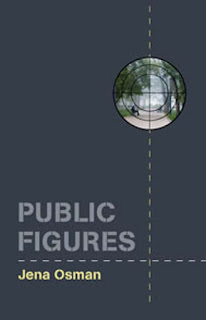
PUBLIC FIGURES, Jena Osman (Wesleyan 2012)

N.B. I'd forgotten I'd dashed this off back when Osman's book first came out. Apparently I'd thought better of submitting a rather negative piece but now I've reconsidered. I've never been a fan of Osman's conceptually overdetermined work. Yet this was was a book I held out hope for when it first appeared. Instead it proved to be a deep disappointment.

This book-length poem-essay is written in the spirit of Benjamin and Sebald (with a nod to Paul Virilio’s work in “War and Cinema”), focusing on the construction of the historical gaze. How do public “figures” – commemorative statues by and large erected to mark military campaigns and victories – shape, that is, figure public space? These lieux de memoire, as Pierre Nora calls them, not only elegize historical events, but inform the social and psychological commons, the space of everyday life.

The book hinges on the conceit of the statuary gaze. “The idea occured.//Photograph the figurative statues that populate your city. Then bring the camera to their eyes (find a way) and shoot their points of view. What does such a figure see?” In the photos that accompany the text, we get a few underwhelming shots of some statute’s line of sight, which is hardly the same thing as “what they see.”

This method wants to provide a powerful way to think about public space though it runs the risk of de-historicizing the very issues Osman wants to re-historicize. Statutes don’t gaze but are meant to be gazed at, of course. But if they could be said to gaze at all then what they see is neither the past nor the future, but the present, mapping it as an eternal now stripped of trauma, a kind of amnesia performed in the very act of commemoration by which civilization elides its own barbarism. As Benjamin remarked, “historicism is a vulgar naturalism.”

Public Figures follows rather loosely a tradition of documentary poetics that runs from Muriel Rukeyser’s “The Book of the Dead” through much of Charles Olson and Susan Howe’s work on American history. Like Olson and Howe this is a book about the latent possibilities of form, especially form conceived of as an act of political intervention. As a meditation on history however it is somewhat banal. As a meditation on the possibilities for the non-lyrical poem it breaks some new ground, but occasionally where it reaches for the essayistic mot juste only manages the flattest of platitudes.

Image: Thinly masked critiques at the end of the disasters.
The leader as bishop is a hawk with heads sutured at the ends of each wing.
With knees in the mud.
The parrot, the ass, the dog, the monkey, the wolf.
Infantalized humanoids, all cower in their bestial cover behind the leader like a
cloud, his wings holding back their perfidy of which he is a part.
You are the shadow at the back, looming like a trace of escape.

Caption: Man with safety orange sweater looking in backpack, then putting it on back.
Man running while on cell phone. Family of three. Troupe of charlatans.

Story: You’ve been evaluating your options. On the one hand, all has gone according to plan. On the other hand, you feel yourself losing your motivation, your focus. The data set is missing a crucial page, buried at the scene. Focus on what matters: Timing. Persistence. Clarity of purpose. The landscape is secondary.

The three tiers of response move from immediate perception to common details to fractured narrative and confused self-reflection, inviting the reader to take part in the process Osman follows in her historical detective work. The effect is deliberately unsettling and disjunctive, with the richness of impression giving way to a deflated language of evaluation. This kind of writing, nurtured during the 90s at grad programs in Buffalo and elsewhere, strains for a new kind of verisimilitude, mixing genre styles, collage-like, to affect a new dialectical image, as Benjamin describes it, whereby disparate objects from different cultural moments produce a sudden illumination of the past. But the effort falls short.

To be fair, Osman’s not really after lyric intensity here. The deliberately prosaic tone of her anti-poetry works to fend off the temptations of the merely beautiful, as if beauty and political commentary were somehow incompatible. (By way of contrast one thinks, for instance, of the late work of Geoffrey Hill, whose inquisitions into the power of the state ring with lyric fury).

No one could ever accuse Osman of acceding to the demands of melopoeia, much less actual prosody. For her, a poem is as dry a report on experience as an annual corporate earnings sheet. She’s a specialist in deflated frisson. The idea here seems to be that ekphrastic writing can not only be bent toward political ends, but that by producing a warmed-over dialectical shock of recognition the reader will be jolted into new awareness of public space. While some of the poems here do accomplish that most of them merely reify the very thing they want to reveal.

Interspersed with the book’s reflections on statuary, snippets of military jargon culled from The Forever Wars in the Middle East act as vaguely intended counterpoints. These are transcripts, we are informed, from various drone pilots to be found on You Tube. The language of course is clipped, dry, matter of fact. It’s difficult to know what Osman intended to achieve with this gimmicky juxtaposition.

“possible new target approaching target one building
designate new target target five pilot copies sensor”

There’s no indication if these communications have been altered or edited, as seems the case, or if Osman transcribed them as is. This is in itself constitutes a case of bad faith, the verbal equivalent of presenting edited footage, with its elisions and cuts, as “the way it really happened.”

For the most part, Osman’s project in Public Figures is resolutely local, focused on her own immediate environment in monument-rich Philadelphia (she is a professor at Temple), a city awash in patriotic “heritage.” She conducts her interrogation of the lived experience of public spaces in order to probe the way they shape the political unconscious of the daily personal sphere, the background replacing the foreground.

But one wonders how she might have dealt with something on the order of St.-Gauden’s monument to Shaw’s 54th regiment in Boston. Its famous rejoinder, Robert Lowell’s “For The Union Dead,” does some of the anti-monumental cultural work Osman takes on, splicing present with past. Lowell’s poem is charged with tremendous affective energy, a quality conspicuously lacking in most younger experimental poets today, who eschew emotion for the kind of desiccated clinical language of a theory seminar. One might call it poetry by poets who can’t write poetry. In the 1990s this seemed radical, offering the hope for new possibilities in poetic rhetoric and critique. By 2012, it’s become dated: formulaic and, finally, forgettable.

Friday, September 24, 2021

On the Abuse of Beckett

Distinguished legal scholar and Obama appointee Cass Sunstein, of Harvard Law School, former spouse of the fabulous Martha Nussbaum and current partner of Samantha Powers, recently contributed a piece to the NY Times on "YOU BET YOUR LIFE From Blood Transfusions to Mass Vaccination, the Long and Risky History of Medical Innovation" by Paul Offit. You can read it here:

https://www.nytimes.com/2021/09/21/books/review/you-bet-your-life-paul-offitt.html

It's a decent, even-handed review, which he probably dashed off on a weekend, like we all do.

Sunstein is, as should be obvious,impressively accomplished. I recall reading some of his early work on constituional law when I was in grad school for purely personal reasons I no longer remember. But he was the real McCoy. Now that he's ascended into the upper atomsphere, he's taken to writing trendy books on trendy subjects, no doubt hoping to cadge a trendy prize like so many of his peers (thinking of you here, Stephen Greenblatt and Merve Emre). Isn't one Malcolm Gladwell already one too many?

He may be a brilliant legal scholar but his understanding of modernist literature is, to say the least, lacking -- as I hope I make clear in what follows. This is an expanded version of a letter I sent to the Times. I'm grateful to Sunstein for provoking me to think throgh the logic of Beckett's work, which I've been reading for the better part of 40 years and to which I always and inevitably return.

To the Editor of New York Times Book Review:

Cass Sunstein’s too clever by half hook for his review of “You Bet Your Life” is mistaken on two counts. Sunstein writes, “In his 1983 novella ‘Worstward Ho,’ Samuel Beckett wrote his most famous words: ‘Ever tried. Ever failed. No matter. Try again. Fail again. Fail better.’ The history of medicine consists of trying and failing, trying again, failing again and failing better.” As anyone even slightly familiar with Beckett’s work can attest, his most well-known quote occurs at the end of the 1953 novel “The Unnamable” – namely, “you must go on, I can’t go on, I’ll go on.”

Despite the phrase “fail better” being co-opted by the tech-bros of Silicon Valley as a mantra for product development, it does not carry an aspirational message about a continual cycle of innovation. To the contrary, “fail better” signifies that the human condition will always be one of failure and that we must learn to accept it, to purify it, as it were, to commit to it fully since there is finally no escape, no alternative to the hopeless plight of our striving. There is hope; there will always be hope. But for Beckett the comedy of our predicament means that it can never be fulfilled.

“Fail better” is a spiritual vow, not a marketing slogan. Please make a note of it.

P.S. The thing about Beckett is that he never extinguishes hope. He makes it clear though that while its attainment is impossible, its fulfillment perpetually deferred, we can never not hope. This is our predicament. The central tension in his work derives from an appeal to hope and the recognition that it can never be fulfilled. This is why Godot never appears. This could aptly describe the films of Chaplin. In “Modern Times,” the film of his I know best, he fails spectacularly at everything he sets his hand to. Yet the final shot shows The Tramp and The Gamin jauntily walking off in the sunset to nowhere.

Failure thus becomes its own achievement, an end in itself, rather than something to be overcome. This is the source of the grim comedy that animates all of Beckett’s work. We are condemned to an utterly bleak situation – the comedy arises from the growing awareness of an surrender to that bleakness. This is why Beckett may finally be understood as a profoundly spiritual writer.

Sunday, August 8, 2021

FUGUE MEADOW, Keith Jones (Ricochet Editions, 2015)

Note:this review originally appeared in John Tranter's now defunct online Journal of Poetics Research.

Just at the outset of his career, American poet Keith Jones is already writing with the confidence and élan one expects from a fully mature writer. His scintillating poems are both demanding and vibrantly lyrical, steeped in the disjunctive complexities of the modernist legacy. His work so far, collected in two short, but powerful, books, demonstrates a deep commitment to the intricacies of the dissonant word and its multiple, fragmented registers of melos and meaning.

Jones’s first book, Surface to Air, Residuals of Basquiat (Pressed Wafer) was a finely textured response to the late painter’s work through a series of tightly symmetrical poems: three stanzas with two lines each, and a final couplet set off in counterpoint at the bottom of the page. Stark and antiphonally layered, they had the effect of opening up Basquiat’s methods in surprising ways, illuminating both his work and his life from a variety of angles.

Fugue Meadow, his latest book, is similarly keyed around another path-breaking postmodern artist, jazz trumpeter Don Cherry who in 1969, with drummer Ed Blackwell, recorded Mu, a double-album that many consider to have sounded the first notes of world music. The book is dedicated to recent victims of racial violence in America, Michael Brown and Eric Garner among them, making a direct link between the cruel inequities still visited upon black Americans and Cherry’s vision of a polyracial musical paradise. As Jones writes in the opening poem, the new still carries a revivifying power:

new down here new moss new spring grass this song
might as well feel this way this weave

this fold

Like Cherry, Jones is concerned with the weave and fold of sounds and words. How folding and refolding generates new sounds, new connections, a set of new possibilities for the poem. Or as Jones puts it elsewhere, in what might be a statement of the book’s defining principle:

We are a new theft
at the limit
of the borrowed

Poetic imagination thrives on theft. So the limit of the borrowed is also the threshold of the utopian still-to-come. The utopianism of Cherry’s music is announced in the album’s title – “Mu,” for music (and Fugue Meadow rhymes and echoes that with its first syllable); but also “Mu,” the legendary lost continent in the Pacific whose prehistoric destruction by geological cataclysm led to a vast global diaspora, a seeding of peoples and customs from India and Peru to Greece and Egypt.

Mu, like OM, might also be thought of as an attempt to represent the ultimate phoneme, the original sound which gave rise to all other sounds. Indeed, as Nathaniel Mackey, whose own “Mu” series derives loosely from Cherry’s music, notes in his preface to Splay Anthem, “any longingly imagined, mourned or remembered place, time, or condition can be called ‘Mu.’”

”Mu” in this sense is less a piecing back together of lost fragments from some original whole, than a vision of a utopia-to-come. “Mu” represents a new global potentiality – the belated emergence of a world sound that is also, in Hegel’s term, world-historical, signaling through music Spirit’s coming into a new awareness of itself.

But where Mackey takes “Mu” as the basis for an ongoing mythopoetic series investigating the afterlives of diaspora, Jones’ focus is narrower; resolutely historical, a tapline into personal echoes and resonances evoked by Cherry’s powerful and haunting music.

BLACKWELL STUDIES /BLUE MOUNTAIN PLACE / HAVEN A FAR SHORE

I go in from Syracuse nude & with energy. to find the space: the infinite series:

the arc’s quiet math: “Do not disturb my circles”

I am painting the air within, tree-limbed, pointing to night. I will roll the infinitesimal /

soldiers fleeing what you sing, now we say lunar, the tuck of spirit, big bold nothing
obscure

launching a thousand ships, caves-in the halo of yr ceiling

after you, chance is measure, chance

is breath

With its wry punning on the drummer’s name and a series of academic books published by Blackwell this poem draws together themes of intuitive seeking and political resistance. In a poetry dedicated to an “infinite series,” one that impels soldiers to flee by its unsettling music, chance can be the only measure. To follow the music where it leads you – no wrong notes, only next notes. Only next breaths.

In an audacious act of confidence, Jones invites his readers to follow the poems while listening to Cherry’s music at a website the publisher, Ricochet Editions, has generously provided. Fugue Meadow produces a multi-collaborative site, one in which poet, reader, and music interact and form recombinant modes of listening. “To duet/a numinous/sound.” Jones’ exquisitely calibrated poems offer an annotated deep listening – the most through-going kind of attentiveness one artist can pay another: not translation but response. There’s an acute, almost micro-tonal act of hearing at work here. The poems fall fold over fold into further fold – a force-field of folds, reticulate, echolaic. One example will have to suffice. This is from partway through “[Track Eight 0’42”]” – which corresponds to Cherry and Blackwell’s sublime composition “Bamboo Night:”

5’54”. heart round peak, like hard nipple, one go upland, toward sky
to dance. to get new, to ground many in love.
say it twice. with yr feet.
love dance
map.

“Love/dance/map” – the simple circularity of this triad spells out an entire poetics. The root of the poem is in the rhythm of the music, in the dance, as Pound once asserted. Reading this while listening to “Bamboo Night” draws one into an intense erotic duet: flute and drum; love/dance/map, intertwining and playing off each other. While it’s not necessary to listen to Cherry’s album or even know it to appreciate these poems, some familiarity with it will open up Fugue Meadow to new levels of attunement.

A fugue meadow names both a musical structure and a field where rigid notions of cultural identity dissolve. To enter a fugue state is to carve inner time out of linear time – to be in time as time, singing it as its very transpiration and expiration, a breath consuming itself for the sake of withness and witness.

the sorrow with which it is twined

a vacating of loss in the kingdom of loss

a broader finite condition

rhythms linked to Mu’s vanishing

an inquest, an inquisitor’s kiss

Breath is everything for the trumpet player and the poet, the caesuras here marking the necessity of breaks, little ruptures, in the texture of the lyric that allow the lost fragments of sunken Mu a way back into song. Fugue Meadow accomplishes what we long for song to do: to lose our way in order to find it; to undergo exile as a form of home.